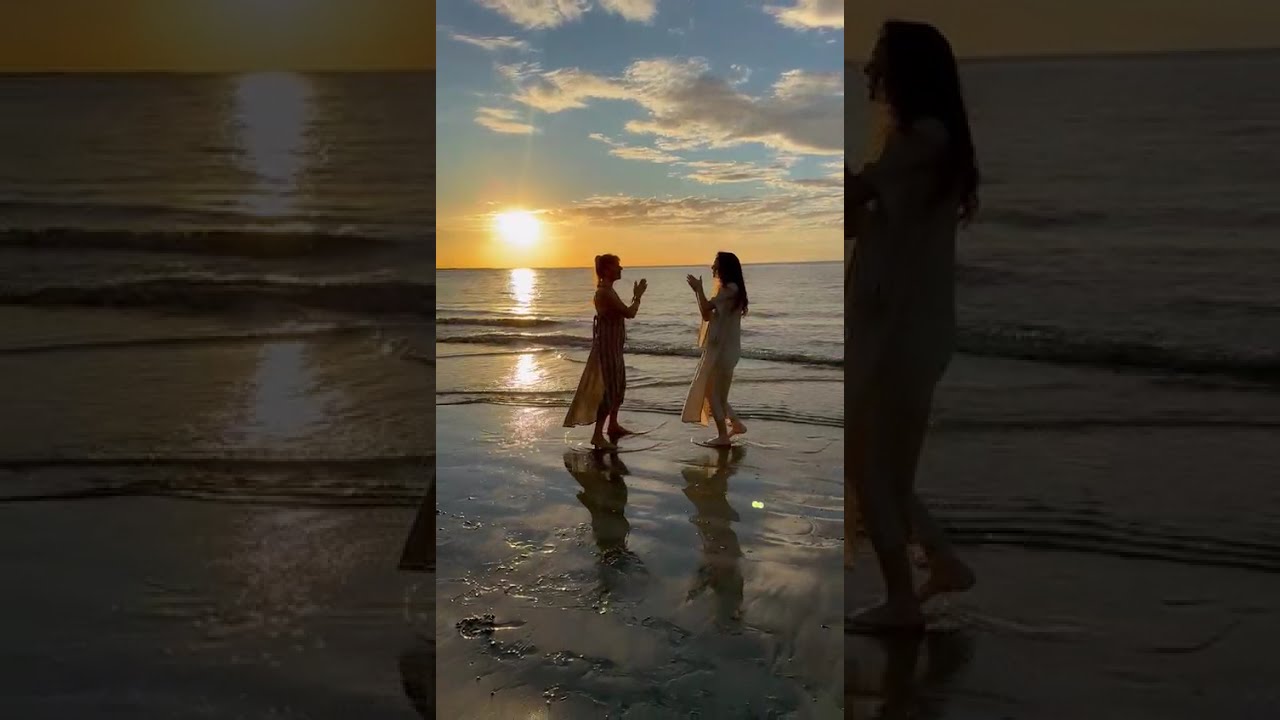
Donna De Lory's "The Unchanging" is a devotional kirtan that holds the paradox of an eternal, unchanging consciousness that exists beneath and within the perpetual flux of creation, time, and emotion. Through lyrics that move between past and present, fear and safety, the isolated self and the interconnected whole, the song articulates a non-dual spiritual recognition: that even as all things change—feelings, days, even our sense of separation—there exists a witnessing presence ("You live in me") that remains constant. The Atom Smith remix deepens this meditation with electronic layers that create a sense of vastness.
What Is the Central Paradox of "The Unchanging"?
At the heart of the song lies a fundamental spiritual paradox: how can consciousness be unchanging while everything around it—and within it—perpetually transforms? De Lory does not resolve this paradox intellectually but holds it as lived experience. "Everything is changing beneath the stillness of the sky," she sings, establishing that change and stillness are not opposites but complementary dimensions of reality. The unchanging is not inert or absent; it is the ground upon which all change occurs. It is described as active presence: "You live in me," addressing the unchanging consciousness directly, suggesting it is not remote but intimately inhabiting awareness itself.
The lyrics move through temporal registers—"far away in a distant past," "another time," "yesterday"—not to romanticize past states but to illustrate that across all moments and epochs, something persists. Words spoken in other times "live in me now," collapsing historical distance and suggesting that meaning and presence transcend chronological sequence. This is not mere nostalgia but an insight into how consciousness relates to time differently than the ego does.
How Does Fear and Blindness Relate to Spiritual Recognition?
De Lory names psychological and perceptual obstacles directly. "A fear that I could fall, blinded by the light of yesterday"—this describes the ego's defensive stance, its way of being disabled by past experience and the residue of former states. To be "blinded by light" is a spiritual inversion: enlightenment or clarity, when met with unpreparedness, becomes overwhelming rather than liberating. The lyrics suggest that the habitual self cannot simply absorb or integrate the unchanging directly; there must be a shift in how one relates to it.
Yet the song does not dwell in this darkness. The passage pivots: "but on this step I can't see, but hid behind the mystery"—acknowledging that visibility and comprehension are not the primary mode of meeting the unchanging. Instead, there is a hand extended ("I take your hand"), a relational turn away from individual striving toward an act of trust. Mystery is not a failure of knowledge but the texture of genuine encounter with what cannot be grasped by the thinking mind.
What Does "I Don't Walk This Path Alone" Mean in a Non-Dual Context?
This line operates on multiple registers simultaneously. On a personal level, it is comforting: the journey is supported. On a non-dual level, it articulates that there is no separate entity walking. The "I" is not isolated; it is already part of the whole, already accompanied by the unchanging consciousness from which it cannot actually be divided. The path is walked, but not by an autonomous ego. De Lory sings "everything is changing beneath the stillness of the sky" immediately after, emphasizing that while the apparent self and its circumstances transform endlessly, there is a witnessing presence—the sky—that holds the entire dance without being moved by it.
This recalls classical Advaita Vedanta imagery: the sky as akasha, or space, which is untouched by the weather that passes through it. All the movements—fear, feelings, emotions, the sense of separateness—are weather. The unchanging is the sky itself, and the recognition "You live in me" is the dawning awareness that I am not separate from the sky; I am the space in which all weather occurs.
What Is the Significance of "Each Step I Take a Passing Tree" or "Passing Dream"?
These metaphors are crucial. They reframe each moment, each experience, each identity the ego claims as fundamentally transient. A tree encountered on a path is beautiful, real, present—but it does not define the path itself. A dream, while vivid during the dream, dissolves upon waking. By describing lived experience as "passing," De Lory is not diminishing its reality but clarifying its ontological status. The personal journey—the apparent spiritual path—is real but not ultimate. It is appearance within the unchanging, like a tree on a road that stretches beyond any single tree, or like a dream within waking consciousness.
This dissolves the common spiritual misconception that one must "achieve" or "become" something. The unchanging is not at the end of the path; it is what the path moves through. There is nothing to become that is not already the case. Each step is a passing appearance, and yet the walker—the awareness that takes the step—is never born, never dies, never becomes anything other than itself.
How Does the Chorus Deepen the Recognition?
The repeated assertion "Still you live in me, the unchanging" is not a theoretical statement but a mantric invocation and affirmation. It reorients consciousness toward direct address: the unchanging is not "out there," not an abstract principle, but "you"—a presence that can be spoken to, that dwells within awareness. The repetition functions as a corrective to habitual identification with thought and emotion. Each return to "still you live in me" is a micro-pause, a moment where the testimony of the unchanging presence punctuates the flux of narrative experience.
The "light" mentioned later—"in the light I hear a calling of one was and one will be"—points to a unified consciousness that transcends temporal categories. "One was" (past), "one will be" (future), and by implication, "one is" (present) are all expressions of a singular, unchanging reality. The "cry of two souls yearning to know the one" describes the spiritual longing itself: the apparent duality of the seeking self and the sought Self are yearning to recognize their non-difference. This is not aspiration toward something distant but recognition of what is already the case.
What Is Meant by "The Dance of Creation Changes Around Me"?
Here the perspective shifts to one of witnessing. The dance of creation—birth, death, time, causality, the entire cosmos—changes perpetually. But from the vantage point of the unchanging consciousness, this dance is observed, held, permitted. The imagery of eternity and halls of eternity suggests a vast, spacious presence that is not imprisoned in any single moment or form. "I shall remain the same" is not assertion of ego stubbornness but recognition of the eternal witness that is untouched by the transience it witnesses.
De Lory then sings "see as you come"—a grammatically open phrase that could mean "perceive/understand as you arrive" or "be witnessed as you come into being." There is an invitation here to align one's seeing with the see-ing of the unchanging consciousness itself, to recognize the world not from the perspective of the small self but from the vastness that precedes and encompasses all appearance.
How Does the Atom Smith Remix Enhance the Song's Message?
The electronic remix layers add a quality of spaciousness and timelessness absent from live acoustic renderings. Synthesized elements create an almost ethereal backdrop, a sense of vast, impersonal presence—sonically evoking the very stillness and immensity the lyrics describe. The rhythm, while contemporary, has an almost meditative quality, allowing the lyrics to float within a field of sound rather than being propelled by traditional song dynamics. This production choice mirrors the song's content: the personal voice (De Lory's vocals) singing within a vast, supportive field (the electronic atmosphere), itself a sonic metaphor for individual consciousness within the unchanging whole.
Where to Go from Here
Listeners drawn to "The Unchanging" might explore Donna De Lory's broader body of work in kirtan and devotional singing, which consistently points toward non-dual recognition. The themes here align with Advaita Vedanta teachings on the nature of consciousness, Brahman, and Maya—the appearance of multiplicity within unity. Reading primary texts like the Ashtavakra Gita or Avadhuta Gita would provide philosophical context for the paradoxes the song holds. Additionally, listening to the song repeatedly as a meditation—allowing it to become mantra rather than merely information—can shift the function of the work from intellectual understanding to direct recognition. The invitation implicit in "Still you live in me" is not to believe in the unchanging but to notice, in silence, what never changes even as all experience flows.