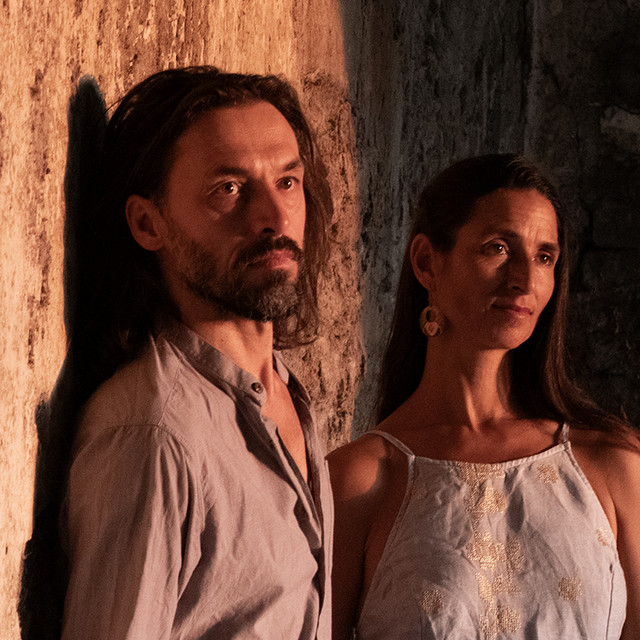
Who Are Mirabai Ceiba and Markéta Irglová?
Mirabai Ceiba is the musical project of Angelika Baumbach, a vocalist and guitarist rooted in contemplative and world-music traditions. The project has built a following through recordings that blend mantric singing, devotional expression, and poetic text with global instrumentation. Markéta Irglová is a singer-songwriter and multi-instrumentalist best known as the Academy Award-winning vocalist from the film musical "Once" (2007). Her voice carries a distinctive clarity and emotional directness that has made her a sought-after collaborator across genres ranging from indie rock to experimental music.
This duet represents a collaboration between two distinct musical voices united around a shared poetic vision. Neither artist approaches the Goethe text from a purely devotional angle; instead, both bring an intimate, conversational quality to the performance, suggesting that the poem's exploration of presence and recognition operates on multiple registers—spiritual, romantic, and philosophically personal.
What Is the Goethe Poem About?
The lyrics, adapted from J.W. Goethe's original poetry, center on a paradox of presence and hiddenness. The poem addresses "the most beloved" and describes how this figure "takes on a thousand forms" and "hides" yet remains immediately recognizable: "At once I know it is you." The beloved is further described as concealing itself "in magic veils" while maintaining a presence "in all"—yet recognition persists.
Goethe was a German Romantic poet and polymath who often explored themes of nature, love, and the ineffable. This particular text operates on multiple interpretive levels. Read romantically, it describes a lover whose essence transcends physical appearance or circumstance. Read philosophically or spiritually, it suggests a recognition of unified consciousness beneath the multiplicity of forms—a theme resonant with non-dual philosophy and mystical traditions. Read psychologically, it speaks to the way presence and identity persist in consciousness regardless of external transformation or concealment.
The adaptation preserves Goethe's original density while rendering it singable. The repeated phrase "at once I know it is you" functions as both anchor and refrain, suggesting that recognition is instantaneous rather than deduced. The title—"Take On a Thousand Forms"—frames the poem not as a lament for lost presence but as a meditation on constancy within infinite variation.
How Does the Musical Arrangement Support the Poem's Theme?
The production team, led by co-producers Jamshied Sharifi and Markus Sieber, crafted an arrangement that mirrors the poem's central idea: multiple instrumental voices weaving together into a unified sonic presence. Sharifi, a virtuoso pianist and multi-instrumentalist, contributed keyboards, accordion, bass, and electric guitar alongside his mixing work. Sieber, who also co-produced and played multiple instruments—vocals, guitars, charango, and ronroco (a Bolivian stringed instrument)—recorded his parts at Dolmen Studio in Mountshannon, Ireland. Sharifi recorded at PotaPota Studio in New York.
The inclusion of charango and ronroco—South American instruments—expands the sonic palette beyond European classical tradition, even as the poetry remains Goethe's. This global instrumentation reflects the album's broader theme: diverse forms, unified essence. The accordion, keyboard, and electric guitar layers create textural depth without overwhelming the vocal performances. The arrangement allows Baumbach's and Irglová's voices to remain the primary carriers of meaning while surrounding them with harmonic and rhythmic support that shifts and evolves.
Markéta Irglová's vocal recording was handled by Sturla Mio Thorisson at Masterkey Studio in Reykjavik, Iceland—a geographic separation that symbolically reinforces the duet's structure: two voices recorded in isolation, later unified through production. This remote-recording approach, necessitated perhaps by geography or creative preference, became an aesthetic choice that emphasizes the paradox at the song's heart: separation that yields unified presence.
What Makes This Interpretation of Goethe Distinctive?
Rather than pursuing a historically informed performance of Goethe's verse or a contemporary art-song setting in the classical tradition, this duet treats the poem as a resource for contemplative music-making. The approach is neither academic nor purely devotional; it occupies a middle ground where poetic meaning remains paramount but is transmitted through world-music sensibilities and intimate vocal collaboration.
Baumbach's work with Mirabai Ceiba has long emphasized the intersection of language, meaning, and sonic resonance. By pairing her interpretation with Irglová's voice—which brings a different timbral quality and interpretive angle—the duet resists a single, authoritative reading of the text. Instead, the two voices seem to explore the poem's themes dialogically. One might hear Baumbach's line "At once I know it is you" as an assertion of certainty, while Irglová's echo suggests recognition that deepens rather than diminishes the mystery.
The album from which this song is drawn, "The Quiet Hour," situates this duet within a larger project of contemplative listening and poetic engagement. The production values—with musicians recording across continents and time zones—suggest care and intentionality rather than speed or commercialism. Mastering by Martyn Heyne and executive production by Karan Khalsa (a figure in the yoga and music communities) further signal that this project operates within communities committed to both artistic excellence and meaningful content.
How Do Vocal Performances Carry the Poem's Meaning?
In vocal music, meaning is carried not only by words but by timbre, phrasing, breath, and the relationship between voices. Baumbach's approach to singing has historically emphasized clarity and presence—the voice as a direct transmission of attention. Irglová brings a more conversational, at times fragile-seeming quality that suggests the speaker is discovering the poem's meaning in real time rather than delivering it with certainty.
The duet form itself becomes interpretive. If the poem is about recognizing presence beneath forms, the duet enacts this recognition: two voices that remain distinct yet move through the same musical and textual space. They do not simply alternate lines; rather, they often move in and around each other, creating harmonic relationships that suggest both intimacy and individuation. The listener experiences not a single narrator's realization but a shared exploration.
The repeated phrase "at once I know it is you"—performed as a kind of musical and textual anchor—becomes a moment of validation for both voices. Each time the phrase returns, it carries the weight of everything that has been concealed, transformed, and yet recognized. The vocal arrangement ensures that this recognition is not passive observation but active, affirmative presence.
What Is the Larger Context of the Album?
"The Quiet Hour" is presented as a collection of contemplative music drawing on poetic texts and global instrumentation. By adapting Goethe and pairing European Romantic poetry with South American instruments and voices from multiple continents, the album resists cultural or musical nationalism. Instead, it suggests that meaningful human experiences—love, presence, recognition, spiritual awakening—transcend cultural boundaries and find expression across traditions.
The album was released through Spirit Voyage Records in 2021, a label associated with contemplative music and yoga-informed listening. This context suggests that listeners may approach the work from spiritual or meditative perspectives, though the music itself does not require such framing to be meaningful. The poetic sophistication of the text and the musical craft involved make the work accessible to listeners interested in contemporary world music, experimental folk, or art song as well.
Where to go from here
Listeners drawn to this work might explore Mirabai Ceiba's broader discography, which similarly pairs contemplative sensibility with poetic text and global instrumentation. Markéta Irglová's solo work, available through her website and major streaming platforms, offers a contrasting yet complementary approach to voice and melody. For those interested in Goethe's poetry more broadly, translations by Michael Hamburger or other scholarly editions provide context for the poem beyond this musical adaptation. The broader album "The Quiet Hour" offers additional explorations of the themes raised in "Take On a Thousand Forms," including work by other collaborators and continued engagement with poetic meaning in musical form. For listeners interested in the production and global collaboration model used here, exploring the work of Jamshied Sharifi and Markus Sieber separately reveals their individual contributions to world music, jazz, and contemplative sound design.
]]>