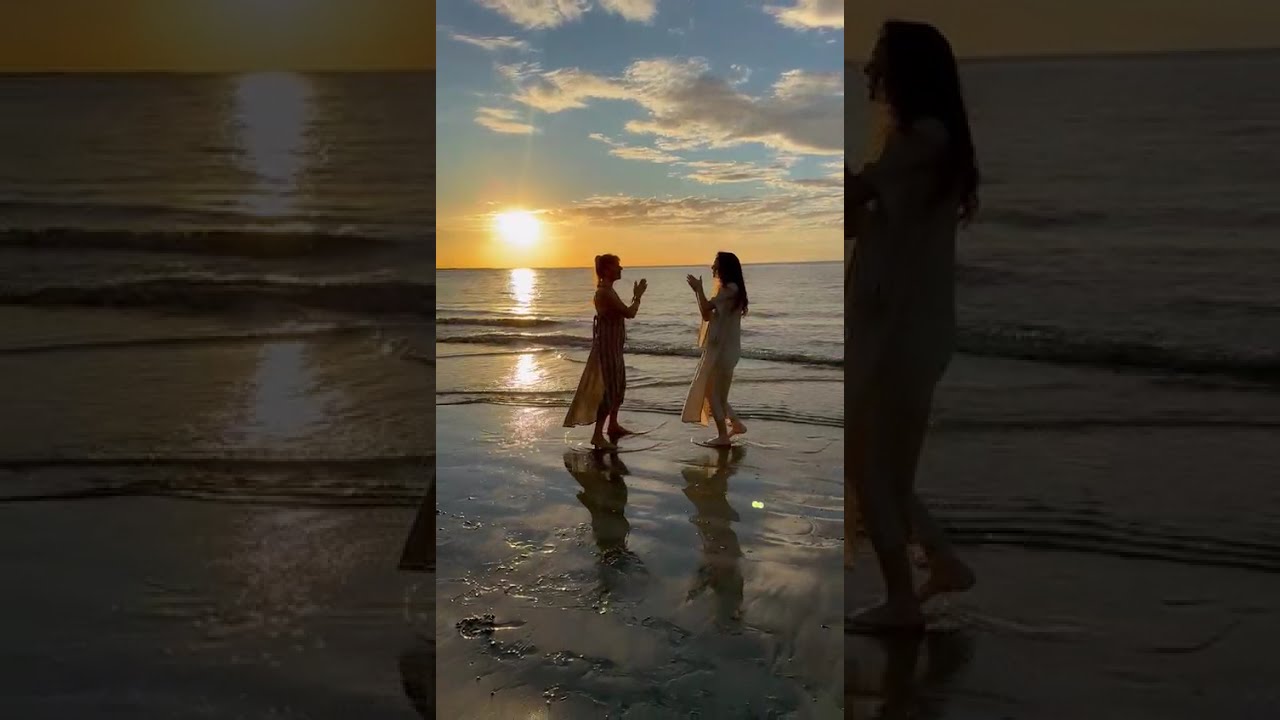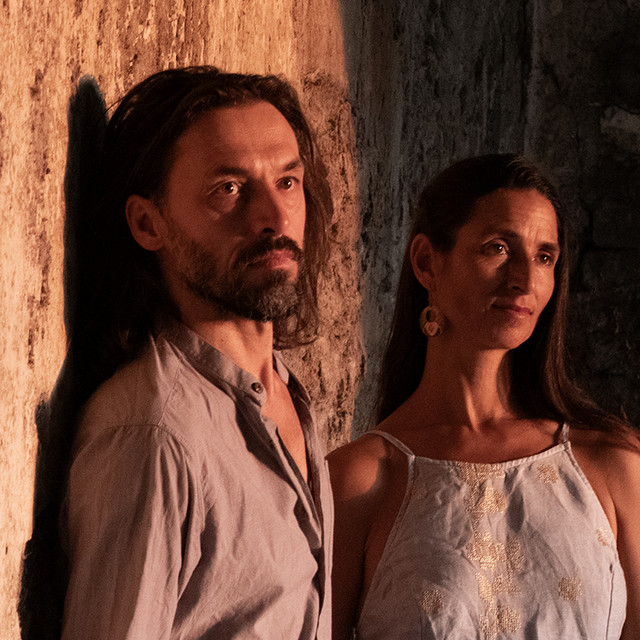
"Pavan Guru" is a Sanskrit devotional chant performed by Mirabai Ceiba at Spirit Fest 2010 that treats the breath and the life force (pavan) as the ultimate teacher (guru). Through call-and-response kirtan with musicians Jamshied Sharifi and Ramesh Kannan, the performance explores how every breath, every impulse, and every instant carries divine presence. The mantra teaches that God—the ultimate king—is continually arriving home through the body's own vital energy, transforming breathing itself into a spiritual practice.
What does "Pavan Guru" mean in Sanskrit and kirtan tradition?
"Pavan" translates as wind, breath, or the vital life force (prana). "Guru" means teacher or guide. Together, "Pavan Guru" names the breath itself as the spiritual teacher—a concept rooted in yogic and Tantric philosophy where the movement of breath is understood as the direct expression of divine intelligence moving through the body. In kirtan, this mantra becomes both a pedagogical and experiential teaching: by chanting it repeatedly, singers train attention toward the subtlety and miracle of each inhale and exhale, discovering that conscious breathing is a gateway to presence and spiritual awareness.
In the Mirabai Ceiba performance at Spirit Fest, "Pavan Guru" is sung in a extended call-and-response format, where the lead vocalist introduces the mantra and the sangat (community) responds, creating a feedback loop that mirrors the natural rhythm of respiration itself. This participatory structure embodies the teaching: everyone in the room becomes both student and teacher, learning from the breath moving through their own bodies.
How does the live kirtan structure support the mantra's meaning?
The Spirit Fest performance uses a classic kirtan architecture: a main vocalist (Mirabai Ceiba) establishes the melodic phrase, percussion (Ramesh Kannan) locks in the rhythmic pulse, and supporting musicians (including Jamshied Sharifi) fill harmonic and textural space. The audience participates by echoing the call, creating what practitioners describe as a "call-and-response loop" that amplifies both the sonic and energetic effect of the mantra.
At 30 seconds into the performance, the basic vocalisation of "pavan guru" begins to crystallize, establishing the primary melodic shape. By 78 seconds, "p heu" syllables emerge—not strict Sanskrit, but sonic explorations that extend and flavor the core mantra, allowing singers to stretch breath and voice in ways that approximate the infinite expressiveness of prana itself. This technique, common in devotional music traditions, treats the voice not as a vehicle for perfect lyrical content but as a resonance chamber for the energy the mantra invokes.
The accompaniment functions as a kind of anchor. While Mirabai Ceiba's voice soars, Ramesh Kannan's percussion maintains a steady heartbeat (taala), preventing the kirtan from drifting into purely ecstatic abandon. This balance—between expansiveness and grounding—mirrors the yogic ideal of pranayama (breath control), where awareness of the breath's movement is held steady even as the experience deepens.
What spiritual significance does "every breath" carry in the performance?
The repeated phrase "every breath, every impulse, every instant" (heard clearly between 293 and 327 seconds) is the doctrinal heart of the performance. It asserts that the divine is not a distant or occasional visitor but is present in the most ordinary, moment-to-moment unfolding of biological and energetic life. Each exhalation is an opportunity to surrender; each inhalation, to receive. Each "impulse"—each spontaneous arising of thought, desire, or sensation—is itself the guru, teaching what needs to be learned.
This teaching reflects the Tantric and Kashmiri Shaivism understanding that divinity saturates material existence; the body is not an obstacle to enlightenment but its primary classroom. By singing "every breath," the kirtan practitioner gradually weakens the habit-bound distinction between the mundane and the sacred, between the mechanical repetition of respiration and the profound miracle of being alive.
The call structure—where Mirabai Ceiba sings "every breath, every impulse, every instant" and the sangat echoes it—creates a collective witnessing of this truth. No one singer owns the insight; it emerges from the field of voices, reinforcing that the teaching belongs to no individual teacher but to the shared breath and life flowing through all beings.
How does the concept of "God coming home" frame the devotional practice?
Beginning around 311 seconds, the mantra extends into "God is coming home." This phrase, paired with "the king of God" (heard at 334–338 seconds), introduces a narrative dimension: the chant is not mere meditation on the breath, but an invocation of the divine as an active, arriving presence. "Home" here suggests return—a resonance with the concept of moksha (liberation) or sahaja samadhi (natural enlightenment), where the soul recognizes its true abode within the body and breath, never having truly left.
The phrasing "the king of God is coming home every breath every impulse every instant" collapses hierarchies of time and space. God—understood here as the ultimate principle of consciousness and aliveness—is not waiting to arrive at some future moment or distant location. The king is arriving *now*, *here*, through the very breath being sung. Each kirtan session becomes a rehearsal of homecoming, a remembrance that divinity has never abandoned the body or the moment.
By 355 seconds, the word "home" is sung out with particular clarity and prolongation, allowing the audience to feel the completion and settling that the word evokes. Yet the kirtan does not end; it cycles back to "guru guru," resetting the cycle and suggesting that homecoming is not a fixed achievement but a continually renewable recognition.
What role does the "force of life" blessing play in the closing moments?
As the kirtan moves toward its conclusion (beginning around 400 seconds), the mantra shifts to "May the force of life be with you"—a benediction that transitions the personal, interior experience of the kirtan into an outward, communal blessing. This phrase, repeated multiple times and amplified by the full sangat, casts the life force not as an abstract principle but as a tangible presence that can be invoked on behalf of others and the world.
The language of "force" echoes not only yogic concepts of shakti (divine feminine power) but also resonates with contemporary spiritual vocabularies (compare the "Force" of Star Wars, which draws on similar archetypal imagery). By using the word "force," Mirabai Ceiba makes the concept accessible without diluting its philosophical depth: the life force is a real, operative power that practitioners are learning to align with and share.
At 438–442 seconds, the phrase "father, may the force of life be with you" introduces a dual invocation: addressing the divine father (the transcendent source) while requesting that the dynamic, embodied life force settle into the gathered community. The performance does not end with the individual meditator dissolved in rapture but with singers and listeners blessed and rekindled, ready to carry the teaching—that every breath is guru—into their daily lives.
How does the call-and-response structure create a learning field?
Kirtan is not a concert performance in the conventional sense, though it may occur in concert venues like Spirit Fest. The architecture of call-and-response is pedagogical: the lead singer offers a phrase, and the community repeats or responds, creating a feedback mechanism. Neurologically and energetically, this structure appears to synchronize the nervous systems of participants, aligning breath, heartbeat, and attention across the group.
For beginners, the response role is forgiving: there is always a moment to hear and follow, no need to anticipate. For experienced practitioners, leading a kirtan (as Mirabai Ceiba does) requires deep listening to the energy of the room, adjusting the pace, melody, and length of each phrase to match what the sangat can hold and deepen. Over the course of the Spirit Fest performance, the energy builds progressively, the voices grow fuller and more confident, and the distinction between leader and respondent blurs—everyone becomes both teacher and student, offering and receiving the mantra.
What is the relationship between rhythm, breath, and spiritual deepening in this kirtan?
Ramesh Kannan's percussion work (likely tabla or other Indian drums) establishes a taala—a cyclic rhythmic framework that repeats at regular intervals. Within this container, Mirabai Ceiba's melodic line and the community's responses can move freely, but never without anchor. The rhythm acts like the breath in pranayama practice: it is the baseline against which all variation and subtlety can be perceived.
As the kirtan progresses and voices gain confidence and volume, the rhythmic pulse remains steady. This creates a paradox familiar to serious meditators and musicians: the more the mind opens and the awareness expands, the more the body's anchor points (breath, heartbeat, drumbeat) become apparent and precious. Rather than floating away into abstraction, deepening spiritual experience in kirtan tends to root practitioners more firmly in embodied presence—the very teaching of "Pavan Guru."
Where to go from here
If "Pavan Guru" resonates, consider exploring Mirabai Ceiba's broader discography to study how she adapts classical Sanskrit mantras for contemporary Western audiences without compromising their philosophical integrity. Listen to other performers of this mantra to hear regional and personal variations; kirtan is a living tradition, not a fixed text.
To deepen your own practice, attend a live kirtan session in your area if possible. The energetic and sonic experience of singing with others cannot be fully replicated by listening to a recording, though recordings like this Spirit Fest performance serve as valuable points of entry and reference. If you are drawn to the pranayama dimensions of the teaching, explore basic breathwork practices (nadi shodhana, alternate nostril breathing) to make the abstract notion of "pavan as guru" more tangible in your own body.
Finally, consider the radical simplicity of the teaching: every breath you take is already teaching you. You need not wait for a guru to arrive, a mantra to be perfected, or circumstances to align. The teaching is available in the next inhale and exhale. "Pavan Guru" is simply a device to remind you of a knowledge you already embody.