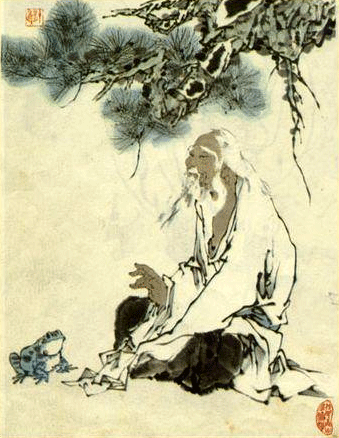
The Essence of Perfection in the Flow of Tao
Chuang Tzu's assertion, "This is the perfection of Tao and its characteristics," invites us to explore the profound nature of the Tao, or the Way, as it manifests in our lives. This statement encapsulates a deep understanding of harmony, balance, and the inherent qualities that define the Tao. In a world often obsessed with ideals and rigid definitions of perfection, Chuang Tzu offers a refreshing perspective that encourages us to embrace the fluidity and spontaneity of existence. Understanding this quote is essential for anyone seeking to navigate the complexities of life with grace and wisdom.
Delving deeper, we find that Chuang Tzu's words challenge conventional notions of perfection, suggesting instead that true perfection lies in the acceptance of the natural order of things. The characteristics of the Tao are not fixed attributes but rather dynamic qualities that reflect the ever-changing nature of reality. This understanding invites us to reconsider our relationship with ourselves and the world, urging us to cultivate a sense of ease and acceptance rather than striving for unattainable ideals. In this light, the quote serves as a reminder that perfection is not a destination but a journey, one that unfolds in the present moment.
The image / the metaphor
At first glance, Chuang Tzu's quote evokes an image of the Tao as a flowing river, where perfection is not a static point but a continuous movement. The use of the word "characteristics" suggests that the Tao possesses qualities that are both inherent and expressive, much like the way water takes on the shape of its container while remaining fundamentally unchanged. This imagery invites us to feel the rhythm of life, where each moment is an opportunity to experience the Tao's perfection in its myriad forms.
Going deeper into the metaphor, we can see that the characteristics of the Tao reflect the principles of wu wei, or effortless action. This concept encourages us to align ourselves with the natural flow of life rather than resist it. In this sense, perfection is not about achieving a specific outcome but about being in harmony with the unfolding of events. The Tao teaches us that when we let go of rigid expectations and embrace the spontaneity of existence, we can experience a profound sense of peace and fulfillment.
In the speaker's tradition
Chuang Tzu's teachings are rooted in the rich tradition of Taoism, which emphasizes the interconnectedness of all things and the importance of living in accordance with the natural order. This perspective resonates with concepts such as sunyata, or emptiness, which suggests that our perceptions of reality are often clouded by attachment and desire. By recognizing the fluid nature of existence, we can cultivate a sense of detachment that allows us to appreciate the perfection inherent in the present moment.
In the Zhuangzi, the text attributed to Chuang Tzu, we find numerous parables and anecdotes that illustrate the principles of Taoism. One such story involves a skilled carpenter who, rather than forcing his work, allows the wood to guide him in its natural shape. This narrative exemplifies the idea that true mastery comes from understanding and aligning with the characteristics of the Tao, rather than imposing our will upon it. In this way, Chuang Tzu invites us to cultivate a deeper awareness of the world around us, recognizing that perfection is found in the dance of life itself.
Living the teaching
Consider a modern scenario where the teaching of Chuang Tzu's quote can be applied: imagine a professional facing the pressures of a demanding job. In striving for perfection, this individual may become overwhelmed by stress and anxiety, fixating on outcomes rather than the process. By embracing the essence of the Tao, they can learn to let go of rigid expectations and instead focus on the qualities of their work, allowing creativity and intuition to guide their actions. This shift in perspective can lead to a more fulfilling and harmonious experience, where the individual finds joy in the journey rather than merely the destination.
In the realm of relationships, Chuang Tzu's insights can also offer profound guidance. Picture a couple navigating a difficult moment, where misunderstandings and conflicts arise. Instead of clinging to the idea of a perfect relationship, they can choose to embrace the imperfections and characteristics that define their connection. By practicing open communication and acceptance, they can cultivate a deeper understanding of one another, allowing their relationship to evolve in a way that reflects the dynamic nature of the Tao. In this way, the teachings of Chuang Tzu remind us that perfection is not an endpoint but a living, breathing process.
A reflection
As we contemplate Chuang Tzu's assertion about the perfection of the Tao, we are invited to reflect on our own lives and the ways we seek to impose rigid definitions of success and fulfillment. What would it mean to embrace the characteristics of the Tao in our daily experiences? How might we find beauty and perfection in the imperfections that surround us? In this spirit of inquiry, I encourage you to consider: How can you cultivate a deeper awareness of the flow of life, allowing its inherent perfection to reveal itself in your own journey?



Join the BrightStar Community
Stay connected with daily inspiration, event announcements, and community wisdom