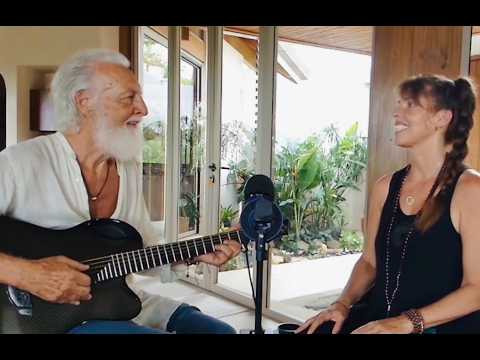
In this teaching, Deva Premal introduces Om Namah Shivaya Gurave, a mantra that invokes the guru principle embodied by Shiva—the energy of transformation, letting go, and eternal consciousness. Shiva energy, she explains, is what allows us to release old structures and burdens in service of new growth. The mantra reflects the eternal, indestructible nature of consciousness itself: that which was never born and will never die. Through the melody composed by Prahful and performed with Miten and Lady Phyl, the teaching becomes both conceptual and visceral, inviting practitioners into a state of reverence, devotion, and readiness for the unknown.
Who is Guru Shiva and What Does the Mantra Ask For?
The mantra Om Namah Shivaya Gurave begins with a fundamental invocation: "I bow down to the guru Shiva." Deva Premal establishes that "guru is the one who takes us from darkness to light." In Hindu philosophy, the guru principle is not merely a person but a function—a force that illuminates what was hidden, that transforms ignorance into understanding. Shiva, in this context, embodies this transformative principle as "such an embodiment of truth, consciousness and bliss." (9-16s)
The description that follows elaborates Shiva's nature across multiple dimensions. Shiva is "the one who is free of worldly illusions"—meaning unbound by the false identifications and attachments that cause suffering. The term "Shantay" describes Shiva as "the one who is peace embodied," which Premal clarifies as "the one who is completely free of identifications" and "shining like the sun, splendid." (20-46s) This image of radiance—splendor—captures an essential quality: when the mind releases its grip on false identity, what remains is inherent luminosity.
What Is Shiva Energy and Why Is It Needed Now?
Premal makes a direct, urgent claim about the present moment: "This is Shiva energy and Shiva energy is really what's needed in this time right now." (48-51s) The reason is functional and ecological. Shiva energy is "the energy that lets us let go of structures of old things of old burdens." (53-60s)
Here, Premal acknowledges a common confusion. Many people associate Shiva with destruction or annihilation. But she reframes this clearly: "Maybe sometimes it looks like destruction but really it's a transformation for the new to come and it's a real important part of the cycle." (63-68s) In cosmological terms, destruction is not an ending but a necessary phase. The old must dissolve for the new to emerge. In personal terms, letting go of outdated beliefs, relationships, or identities creates space for growth. This cyclical understanding—that destruction and creation are not opposites but partners—is central to Shiva philosophy.
The timing, Premal implies, is not accidental. The world at this historical moment requires the capacity to release what no longer serves, to surrender attachment to structures that have become burdensome, and to trust in transformation. This is Shiva's gift.
How Does the Melody Carry the Meaning of the Mantra?
Premal draws attention to the compositional choices made by Prahful, who channeled the melody. She describes it as being "completely reflective of that energy." What energy? Shiva energy—the capacity to let go. She then articulates three qualities embedded in the melody: "It's so inward. It's so with such reverence and such devotion and such readiness for the unknown. Readiness for the unknown to to arrive and to be embraced." (71-93s)
This is crucial: the melody itself becomes a training ground. By singing an inward, reverent melody, the practitioner cultivates inwardness and reverence. By engaging with music that holds readiness for the unknown, the nervous system learns to relax in the face of uncertainty. The mantra is not merely something to be intellectually understood; it is something to be embodied through sound, vibration, and the felt sense of moving through the composition.
What Do the Lyrics Reveal About the Nature of Consciousness?
A key lyric in the mantra is: "never born, never died." Premal identifies this as "exactly Shiva energy. It's eternal. It's that which never never never dies." (105-111s) This is not poetry for decoration; it points to a direct insight about consciousness itself.
In Vedantic philosophy, consciousness is understood as the unchanging witness of all change. Bodies are born and die. Thoughts arise and pass. Identities emerge and dissolve. But the awareness in which all of this occurs—the "I am" prior to all naming—is never born and never dies. It is eternal, beyond time. By chanting "never born, never died," the practitioner aligns themselves with this truth. They are not merely repeating words; they are tuning into something that Premal describes as central to all mantric practice: "this is what we tune into with actually with all the mantras, but especially with the Shiva mantras." (113-117s)
Shiva mantras in particular emphasize this eternal dimension because Shiva is the principle of pure consciousness, undifferentiated and free. To invoke Shiva is to invoke the unchanging awareness that witnesses all transformation.
How Does Miten's Voice Enhance the Teaching?
Premal specifically highlights "a beautiful appearance of Mense's voice in this mantra." (99-101s) Rather than treating different vocalists as interchangeable, she notes that Miten's voice carries the weight of these words—"never born never died"—with a particular resonance. A voice carries intention, texture, and embodied wisdom. The fact that Miten is Premal's long-time collaborator and himself a seasoned practitioner means that his rendering of "never born, never died" is not merely technical but carries the weight of lived understanding. For the listener, hearing these words sung by someone who has integrated this teaching into their own being creates a transmission beyond words alone.
What Is the Relationship Between Guru, Mantra, and Personal Transformation?
The mantra Om Namah Shivaya Gurave is not asking for Shiva to become something other than what they are. Instead, it is asking to recognize and bow to the guru principle already present in the universe and in one's own consciousness. By repeatedly invoking this principle through sound, the practitioner aligns themselves with it. The Shiva energy of letting go becomes available, not as a distant deity's gift, but as an activation of something intrinsic to existence itself.
Premal's teaching suggests that mantra is a practical technology for this alignment. The melody, the words, the vibration of the voice in the body, the communal resonance when sung together—all of these are instruments that attune consciousness to what it is invoking. Over time, through repeated practice, the practitioner does not merely understand that they are eternal consciousness; they begin to experience it. The burden of false identification lightens. The capacity to let go deepens. The readiness for the unknown grows.
Where to Go From Here
To work with Om Namah Shivaya Gurave, consider establishing a regular practice of chanting or listening to the mantra from the album The Inevitable Blossoming of the Heart. Begin by learning the melody and allow the words to become familiar not just to your mind but to your body and breath. When you chant "never born, never died," pause and notice what it feels like to identify with something that cannot be harmed by change. If you are carrying old burdens or structures in your life—beliefs, relationships, patterns—notice whether engaging with Shiva energy helps you soften your grip. Keep a journal of shifts you notice in your capacity to let go, your relationship to change, and your sense of underlying awareness. For deeper study, explore other Shiva mantras and the philosophy of Shaivism. Consider joining a kirtan or chanting group where you can experience the communal resonance of mantra practice. Visit devapremalmiten.com for information on Gayatri Gatherings and retreats where these teachings are explored in depth.