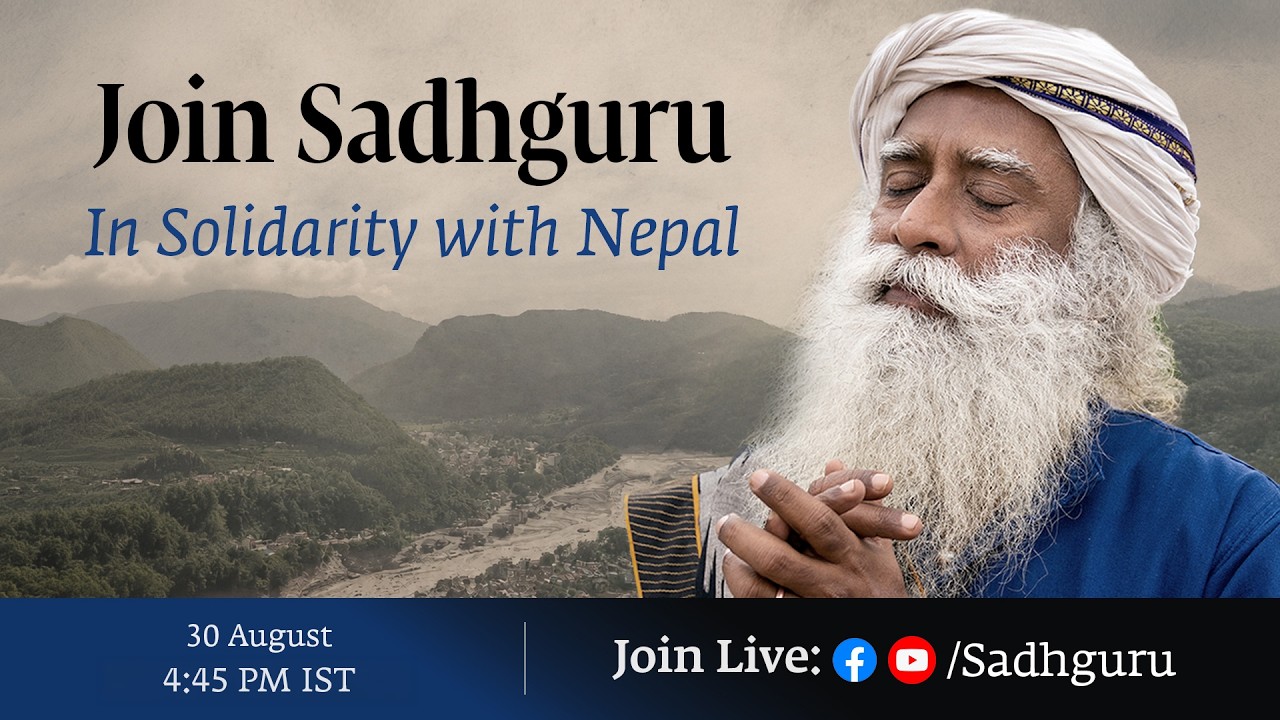
In this extended conversation with Arnab Goswami, Sadhguru addresses fundamental questions about the relationship between success, service, and spirituality; examines what enlightenment means and how it occurs; discusses the role of spiritual practice in developing self-awareness; and offers perspectives on national identity, cultural traditions, and the nature of consciousness itself. The dialogue weaves together personal inquiry, spiritual philosophy, and contemporary social concerns.
What Is More Important: Success, Service, or Spirituality?
The conversation opens with a direct question about priorities in human life. Sadhguru frames this not as a hierarchy but as a sequence. The premise underlying his response is that without addressing the inner condition of human consciousness, external achievements—whether success or service—become incomplete or misaligned.
Spirituality, in Sadhguru's usage, does not mean renunciation or withdrawal from life. Rather, it refers to the quality of one's inner experience and the degree to which a person is conscious of themselves and their place in the world. When this inner foundation is present, both success and service naturally flow from a clearer, more integrated place within the person. The question is not which to choose, but in what order to develop them.
What Happens When Success Comes at the Cost of Others?
Sadhguru explores the ethical dimension of achievement. When someone succeeds by diminishing or harming others, the psychological and spiritual cost is significant. The person accumulates not just wealth or status but also internal fragmentation—a disconnect between their actions and their conscience, between the outer life and the inner reality.
This creates what Sadhguru refers to as a lack of integration. A human being who prospers while others suffer cannot be fully at peace, because consciousness itself is not separate from the world. The pursuit of success at others' expense is ultimately self-defeating because it requires the person to suppress their awareness of the harm they cause. This suppression of consciousness is, by definition, a spiritual problem.
How Human Are You? Fears, Insecurity, Attachments, and Ego
When asked directly about his own fears, insecurities, attachments, and ego, Sadhguru addresses a question many ask about those who claim spiritual attainment. His answer distinguishes between the structure of the human body-mind and the clarity of consciousness within it.
All human beings have the neurochemistry and evolutionary history that generates fear, attachment, and ego-driven impulses. These are not flaws but features of the human nervous system. The distinction is whether a person is conscious or unconscious of these mechanisms. An enlightened person, in Sadhguru's framework, is not someone without fear but someone fully conscious of fear when it arises—able to observe it without identification.
The difference between a person functioning on automatic impulse and one functioning with awareness is the same difference that exists between someone sleepwalking and someone awake. The impulses may still arise, but the person is awake to them. This awakeness is what allows for choice, for wisdom, for action that is responsive rather than reactive.
Why Does Enlightenment Happen to Some and Not Others?
This is perhaps the deepest question in the conversation. Sadhguru addresses the mystery of why certain people experience a shift in consciousness while others, seemingly in similar circumstances, do not. He avoids the trap of making enlightenment seem either random or predictable.
The key distinction he makes is between preparation and occurrence. Enlightenment, as he describes it, is not something you can achieve through willpower or intellectual understanding alone. It is something that occurs when certain conditions are met. These conditions include not just meditation or spiritual practice, but a fundamental shift in how the person relates to their own body, mind, and experience.
For others seeking a similar opening, Sadhguru points toward practices that create the conditions for such shifts: the cultivation of inner silence, the development of sensitivity to one's own being, the willingness to question assumptions about the nature of self and reality. The tools are available, but the actual experience cannot be forced. This points to a paradox central to much spiritual teaching: you prepare the ground, but you cannot plant enlightenment; it flowers on its own timing.
Who Is the Most Self-Aware and Enlightened Person You Have Met?
When asked to identify the most enlightened being he has encountered, Sadhguru sidesteps the ranking of individuals. Instead, he speaks to what enlightenment looks like when encountered: an absence of fear, a lack of pretense, a complete ease with uncertainty and impermanence. These are the markers he looks for.
The answer also implicitly suggests that true enlightenment is not rare in the sense of being unrecognizable. When a person has truly broken free from the tyranny of the ego and the constant need to protect, defend, and accumulate, it is obvious. The evidence is not in their claims but in the quality of their presence.
What Do You Think About the State of the Nation?
Sadhguru turns the lens toward collective consciousness and national well-being. A nation, like an individual, can be more or less conscious, more or less integrated. When citizens are fragmented internally—torn between competing desires, fears, and identities—the nation reflects that fragmentation in its institutions and conflicts.
The health of a nation is not only a matter of economics or military power but of the psychological and spiritual health of its people. A nation where people are more awake to their own nature, less driven by unconscious fear and tribal identity, is naturally more stable and more capable of genuine development.
Why Do Some People Find It Fashionable to Run Down the Nation?
This question gets at a phenomenon Sadhguru observes: the performance of critique as a form of freedom. There is a segment of society that positions itself as enlightened precisely by its distance from national pride, tradition, or collective identity. Sadhguru's analysis suggests this is often a reaction rather than genuine insight.
True freedom is not the freedom to run down what you belong to, but the freedom to see your nation clearly—both its strengths and its failings—without needing to either defend it blindly or attack it compulsively. Running down your nation can be a way of claiming intellectual superiority or rebel status. Real clarity would see both the problems and the potential, and work to strengthen what is valuable while addressing what is broken.
Standing for the National Anthem: Ritual and Respect
The question of whether one should stand for the national anthem in theaters becomes, in Sadhguru's discussion, an opportunity to explore the difference between compulsion and voluntary gesture. Respect that is enforced is not respect; it is compliance.
However, the refusal to stand can equally be a compulsion—a need to prove one's independence or intellectual sophistication. True freedom would be the capacity to stand when moved to do so, to recognize the value of the collective symbol without needing to either worship it or disdain it. The act itself is less important than the consciousness with which it is performed.
Is the Privileged Section of India Cut Off From the Rest?
Sadhguru addresses the reality of class separation in India. The educated, affluent urban class often lives in a bubble, insulated from the lived reality of the vast majority of the population. This separation is not just geographic or economic but perceptual—a different reality is being experienced.
When this disconnect becomes complete, the privileged class loses touch with the actual conditions of the nation and begins to operate on abstractions and ideologies rather than reality. This is a problem for social cohesion and also for the development of genuine wisdom, which requires contact with life as it is lived, not as it is imagined.
Has Europe Invited Trouble With Open Immigration Policies?
Sadhguru approaches this sensitive question without the polarization that often surrounds it. The question is not whether borders should be open or closed in absolute terms, but whether the integration mechanisms are in place. A society that welcomes people but fails to integrate them, or that creates subcultures where newcomers remain separated from the mainstream, creates inevitable tension and conflict.
This is less about the righteousness of immigration policy and more about the practical question of social coherence. If you invite people into your society, you have a responsibility to integrate them—to help them understand your values while making space for theirs. The failure to do this creates the very conflicts that generate backlash against immigration.
What Would You Do About Terrorism as a Political Leader?
When presented with the hypothetical of leading a nation facing extremist violence, Sadhguru shifts the frame from military response to psychological and spiritual response. Terrorism, he suggests, works on the principle of creating fear and division. The conventional response of escalated security and force may address symptoms but not the root.
A deeper approach would recognize that terrorism succeeds when people are disconnected from their own inner stability and easily frightened. Building a society where consciousness is higher, where people are less reactive and more grounded, is a less flashy but more durable approach to the problem. This does not mean ignoring immediate threats, but addressing the soil in which terrorism takes root.
When Terrorism Becomes a Thought Process, How Do You Counter It?
Sadhguru distinguishes between terrorism as a tactic and terrorism as an ideology—a way of thinking that normalizes violence against those deemed enemies. When this becomes embedded in people's consciousness, military solutions become limited in their effectiveness.
The counter to an ideological movement is not primarily military but educational and cultural. You must offer people a way of thinking and living that is more compelling, more fulfilling, more aligned with their deepest values than the ideology of violence. This requires addressing people's sense of grievance, marginalization, and meaning.
Women in Temples and the Bull-Taming Tradition
Sadhguru's positions on keeping women out of certain temple sanctums and supporting jallikattu (the traditional bull-taming sport) seem contradictory to those who view them as restrictions on freedom. His explanation reveals a distinction between the letter of tradition and its function.
Some temple practices, in Sadhguru's view, are rooted in an understanding of energy, ritual, and the purposes that the space serves. These are not meant as insults to women but as specific applications of knowledge about how human energy works. Similarly, jallikattu, despite its apparent cruelty, embodies a relationship between humans and animals that has deep cultural meaning and, some argue, serves the well-being of the breed.
The tension here is real: how do you preserve traditions that contain genuine wisdom while also ensuring that they do not become vehicles for discrimination? Sadhguru's answer is not to reject tradition wholesale but to understand its purpose and adapt thoughtfully rather than react against it from a place of ideology.
What Are the Tools for Self-Enrichment and Self-Consciousness?
Sadhguru identifies several concrete practices that develop both self-awareness and spiritual depth. Meditation is primary—the systematic training of attention and consciousness. But beyond meditation, he points to practices that increase one's sensitivity to the body, the breath, and the subtle dimensions of experience that most people move through unconsciously.
Self-inquiry—the practice of asking fundamental questions about the nature of self, reality, and existence—is also crucial. This is not intellectual philosophy but direct investigation into your own experience. Who am I? What am I conscious of right now? What is the nature of this experience I call "me"?
Additionally, Sadhguru emphasizes the importance of moving the body in ways that increase sensitivity and awareness. Yoga, in his understanding, is not exercise but a tool for refining consciousness through the body. The physical practice creates the conditions for deeper states of awareness to emerge naturally.
The Vedas, Gender, and Temple Access
A follow-up question highlights an apparent inconsistency: if the Vedas teach that the soul has no gender, and if modern society is accepting of widow remarriage, why persist with restrictions on women in temples? Sadhguru addresses the distinction between theoretical philosophy and practical application.
The non-dual understanding of the Vedas—that the ultimate reality transcends all categories, including gender—is profound and true. However, as long as consciousness is embodied in a gendered body, those distinctions matter functionally. It is not a contradiction to hold both: ultimate truth transcends gender, and embodied practice must work with the reality of gender.
The question of why certain temples maintain restrictions is not answered by ideology alone. Sadhguru suggests that the practices within those spaces have specific purposes and effects related to energy and consciousness. Whether these distinctions will persist as consciousness evolves is an open question, but the answer is not simply to dismiss them as patriarchal without understanding their actual function.
What Changes Would You Make as Prime Minister?
When asked what single change he would implement if he were leader of the nation, Sadhguru points not to policy but to consciousness. The most important change would be to increase the general level of awareness and psychological health of the population.
If people were more conscious, less reactive, less driven by fear and tribal identity, most other problems would either solve themselves or become far easier to address. Education systems would naturally become more human-centered. Economic policy would balance growth with well-being. Conflict would be less violent and more resolvable. The root problem is not institutional but existential—the low level of awareness in most humans.
Imagination Versus Perception: The Thin Line
The final question addresses a fundamental epistemological problem: how do you distinguish between what you are genuinely perceiving and what you are imagining or projecting? This is a crucial question because our sense of reality is built on what we think we perceive.
Sadhguru's answer rests on the development of awareness. Most people live in a perpetual blur of imagination, memory, and projection that they mistake for direct perception. The mind is constantly interpolating, filling in gaps, creating narratives. True perception requires a state of awareness that is clear, undisturbed by the mind's interpretations.
The way to develop this clarity is through practices that quiet the mind and heighten sensitivity to direct experience. When you sit in meditation, you gradually begin to see how much of your experience is imagination. You notice thoughts arising, emotions coloring your perception, memories overlaying the present moment. As this awareness develops, you can begin to distinguish between what is actually happening now and what the mind is making up about it.
Where to Go From Here
This conversation touches on domains that cannot be fully resolved through intellectual debate: the nature of consciousness, the purpose of spiritual practice, the tension between individual freedom and collective responsibility, the preservation of tradition versus adaptation to change. Sadhguru's approach throughout is to avoid doctrinaire answers in favor of inviting inquiry.
If any of these topics resonates, the next step is not to adopt Sadhguru's views wholesale but to investigate directly. Begin a meditation practice. Observe your own mind and body with genuine curiosity. Question the assumptions you have inherited about success, spirituality, national identity, and self. Visit a meditation center or ashram if the opportunity arises. Read texts that challenge your thinking. Most importantly, recognize that consciousness is not a belief system but a capacity that develops through practice and attention. The tools are available; the question is whether you are willing to apply them to your own experience.