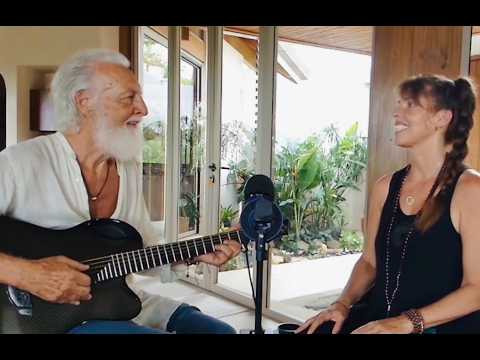
Deva Premal and Miten offer a guided OM meditation tuned to 432Hz—a frequency mathematically aligned to universal vibration—rather than the standard 440Hz. The practice invites practitioners into states of inner silence where thought dissolves, revealing the consciousness beneath mind as a mirror reflecting harmony, joy, and blissfulness. OM, as a seed mantra, represents the "Cosmic Yes" and functions not as language but as a symbol beyond words that facilitates direct spiritual experience.
What is OM and why does it matter in meditation?
OM is not a word that can be reduced to meaning. According to the wisdom traditions preserved across Sanskrit, Pali, Prakrit, and Tibetan texts, OM is written as a unified symbol rather than alphabetic letters—a deliberate choice reflecting that all mystics across ages have accessed the same experience through this sacred mantra. This symbol transcends language itself because OM functions at a level deeper than the mind's conceptual apparatus. It is what remains when everything else falls away: no thought, no dream, no projection, no expectation. Even the surface ripples of consciousness cease, leaving the whole field of awareness as silence—a still mirror.
In meditation, OM serves as the "Cosmic Yes," a seed mantra that aligns practitioners with fundamental frequencies of existence. When chanted or listened to with full presence, OM does not convey meaning through semantics but through vibration. The mantra operates on the body, breath, and subtle energy systems simultaneously, creating resonance that quiets mental chatter and points awareness toward the ground of being.
How does 432Hz differ from standard tuning?
Most modern Western music is tuned to 440Hz, a standard established in the twentieth century. However, 432Hz represents a mathematically different relationship to the frequencies of nature. This alternative frequency is said to be aligned with the vibrational patterns of the universe itself—coherent with natural harmonic series found in planetary orbits, sacred geometry, and the resonances observed in living systems.
When OM is chanted or played at 432Hz, practitioners report experiencing a qualitatively different effect on the nervous system and consciousness compared to the same mantra at other frequencies. The 432Hz tuning is believed to enhance the dimension of inner peace and silence, creating a more direct resonance with the subtle body and the deeper layers of meditation. While the scientific mechanisms remain subjects of ongoing research, the subjective reports of meditators consistently point to a smoothing effect, a deepening of relaxation, and easier access to states of profound stillness when working with this frequency.
What happens in the deepest states of OM meditation?
The deepest experience of OM meditation occurs when the meditator's ordinary consciousness becomes quiet enough to perceive what lies beneath thought. In these rare moments, the whole lake of consciousness becomes still—a condition where there are no ripples, no agitation, no seeking. The mind, which normally churns with narratives and projections, settles into transparency. This state is sometimes called "the sound of silence," and it reveals something essential: that within the depths of inner being, there is already music—an inherent harmony and joy that does not depend on external input.
The value of this experience extends beyond momentary peace. When consciousness touches this inner music, it directly perceives qualities of blissfulness, harmony, and rightness that are always present but usually obscured by mental noise. OM, both as a chanted mantra and as the primordial sound of creation, functions as a frequency key that unlocks access to these dimensions. The mantra does not create these qualities; it removes the obstacles—the thought-forms, expectations, and mental projections—that prevent their recognition.
How does OM function beyond the level of language and mind?
A crucial distinction separates OM from ordinary words and symbols. Language operates through meaning: a word points to a concept, which the mind then processes. OM operates outside this system entirely. It is not part of the mundane world that language describes; therefore, it cannot be adequately represented by alphabetic writing. The choice to represent OM as a symbol across all Eastern traditions reflects a consensus among spiritual practitioners that OM belongs to a different order of reality than speech and conceptual thought.
This distinction has profound implications for spiritual practice. Since OM does not mean anything in the way the mind understands meaning, it does not engage the interpretive machinery of thought. Instead, it operates as pure vibration and frequency. When the mantra is internalized through listening or chanting, it bypasses the conceptual mind and works directly with the nervous system, the breath, and the subtle bodies. This is why practitioners can engage OM repeatedly without the boredom or mental fatigue that often accompanies repetitive use of words: the mantra continues to work at depths the thinking mind does not access.
What does it mean that OM is the "Cosmic Yes"?
OM represents affirmation at the most fundamental level—a yes to existence itself, to the underlying unity and creative principle that animates all things. Unlike a conceptual yes or no, which operates in the realm of judgment and preference, the Cosmic Yes is total acceptance of what is. In this sense, chanting or meditating on OM is an act of alignment with reality as it actually is, rather than as the mind wishes it to be.
When meditation deepens into silence through OM practice, the practitioner moves into this state of cosmic affirmation. The struggles, resistances, and mental contractions that characterize ordinary consciousness dissolve. What remains is a quality of okayness, of fundamental okness with what is. This is not a passive resignation but an active participation in the creative harmony that sustains all existence. The mantra, as seed, contains the whole tree of this experience within its vibration.
Where to go from here
OM meditation at 432Hz offers an accessible entry point into deep contemplative practice. Beginners might start by listening to the Deva Premal and Miten recording for 10–20 minutes daily, allowing the frequency and mantra to work on the nervous system without effort or expectation. As familiarity grows, some practitioners find it supportive to chant OM themselves, either aloud or internally, syncing the breath and vocal tone with the recorded mantra. The key is consistency and the willingness to sit with whatever arises—restlessness, emotion, or sudden silence—without judgment. Over time, the inner music that OM points toward becomes increasingly accessible, revealing the joy and harmony that exist beneath the surface of ordinary mind.