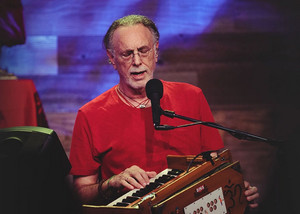
There's a moment in every Krishna Das concert when the room stops being an audience and becomes something closer to a congregation. The call goes out — a single Sanskrit name, repeated — and it comes back doubled, then tripled, until a theater full of strangers is breathing on the same beat. No one is watching a performance anymore. They're inside one.
That transformation, from spectator to participant, is the whole point, and it has taken Krishna Das more than five decades to build the room where it can happen. He was born Jeffrey Kagel in 1947, and his path to becoming one of the most recognized voices in devotional music started not in an ashram but in New York City in the 1970s, where a young man drawn to the teachings of the Indian guru Neem Karoli Baba eventually made the trip to India himself. What he found there — a practice of bhakti yoga rooted in surrender and love — reordered the rest of his life.
The Fusion Nobody Asked For, Until Everybody Needed It
Kirtan — call-and-response chanting of the divine names — is ancient. What Krishna Das did with it was not. He came home from India and began leading kirtans that folded traditional Indian melody into Western musical structure: verse-chorus shapes, harmonium and guitar, dynamics that build like a rock set rather than sit static like a temple recording. It's a fusion that sounds obvious now, three decades and dozens of Western kirtan artists into the movement, precisely because Krishna Das made it work first.

A Lineage, Not a Genre
It would be easy to file Krishna Das under "world music" or "yoga soundtrack" and move on. He'd tell you that misses the point entirely. His music isn't a genre exercise — it's a lineage. Every chant carries the teachings of Neem Karoli Baba forward: the emphasis on love and surrender, the insistence that devotion isn't a performance but a practice. Krishna Das has spent his career trying to make that practice available to people who will never travel to the Himalayas to find it, which is its own kind of translation work — arguably harder than any melody.

In 2014 that translation instinct became an institution: the Kirtan Wallah Foundation, established to extend his guru's teachings and keep the practice of kirtan accessible — not gatekept, not commodified, just available to whoever walks in the door needing it. It's a quiet but telling move for a man whose entire career could have stayed personal. Instead it became infrastructure.
The Room Is the Instrument
Ask anyone who's been to a Krishna Das concert what stays with them, and it's rarely a lyric. It's the room — the specific, collective sound of hundreds of voices finding the same note at the same time, sustained past the point where anyone's thinking about pitch. That's the real instrument he's spent his life tuning: not the harmonium, not his own voice, but the capacity of a crowd of strangers to become, briefly, one thing.

Next Stop
Krishna Das brings that room-as-instrument practice to BlessFest East 2026, taking place in Berkshire, USA, beginning September 10, 2026.