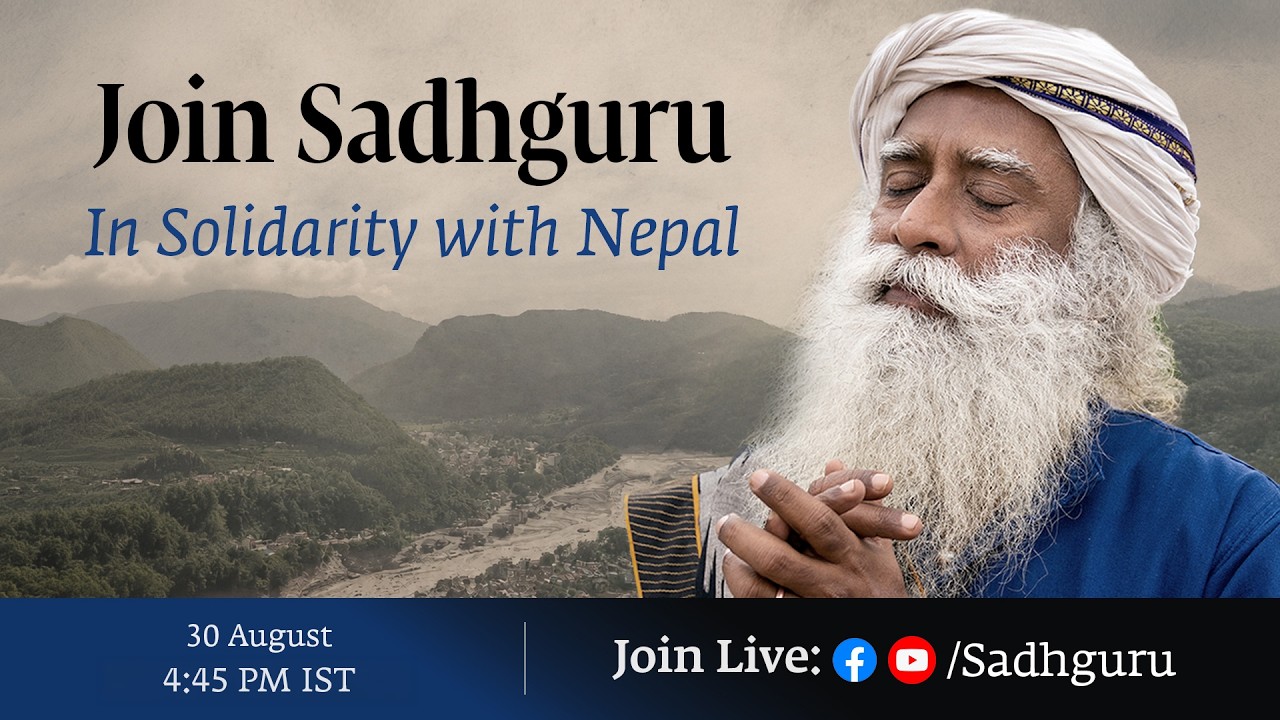
Health is not a concept or achievement to pursue—it is a natural byproduct of proper use. When the physical body, mental processes, and vital energies are regularly exercised, health emerges as an inevitable result. This talk frames health not as something to build or attain, but as something that arises when you stop neglecting the instrument you already have.
Is health something you build, or something that emerges naturally?
Most approaches to health treat it as a goal to achieve—a state to be constructed through supplements, diets, workout programs, or lifestyle interventions. Sadhguru inverts this premise. Health, he explains, is not an invention or an idea that needs to be engineered. Instead, health is a natural consequence of proper use of the body and mind.
This distinction matters because it shifts the frame from "How do I create health?" to "What am I doing that prevents health from manifesting?" The body has an intrinsic capacity for wellbeing. When you use that body—when you move it, exercise it, and engage it purposefully—health follows naturally. This is not theory. It is physiology. When skeletal muscles contract and relax regularly, bone density improves, cardiovascular function strengthens, metabolic pathways activate, and the nervous system recalibrates.
Why does the body need constant use to function well?
The human body is designed for movement and engagement. It is not a static object that, once optimized, remains stable. Muscles atrophy without use. Joints stiffen without movement. The cardiovascular system weakens without demand. Bone density declines without load. The digestive system operates optimally only when there is sufficient physical activity to trigger proper metabolic cycling.
This is not a weakness of the body—it is a design principle. The body thrives on use. It improves through use. The more you use it, the better it gets, because biological systems adapt to the demands placed on them. A sedentary body cannot be healthy. It is not a matter of willpower or positive thinking; it is mechanical. Disuse leads to deterioration. Use leads to resilience and vitality.
What does it mean to exercise the mind, not just the body?
Physical exercise is obvious. But mental exercise is often overlooked. The mind, like muscle, requires stimulation and challenge to remain sharp and adaptive. Cognitive engagement—problem-solving, learning, creative work, focused attention—keeps neural pathways active and promotes neuroplasticity. Without mental exercise, the mind becomes dull, reactive, and prone to repetitive thought patterns.
Mental exercise also includes the ability to manage attention, to sustain focus, and to direct thought deliberately rather than being swept along by habitual patterns. Meditation and contemplative practices serve this function. They train the mind to observe itself and to remain calm under stimulus rather than automatically reacting. This kind of mental fitness is as foundational to health as physical strength.
What are life energies, and how do you exercise them?
Beyond the gross body and the thinking mind, Sadhguru references "life energies"—the vital force that animates the body and allows it to function. In yogic philosophy and Ayurveda, this is called prana. It is not mystical; it is the energetic dimension of physiology: the flow of oxygen, nutrients, hormones, and nervous system signals that keep you alive.
These energies become sluggish when you are sedentary, stressed, or closed down emotionally. They flow vibrantly when you are active, breathing fully, emotionally open, and mentally engaged. Yoga practices, pranayama (breathing exercises), and movement-based disciplines are designed to awaken and circulate these energies throughout the body. When life energies move freely, the body heals itself, the mind settles, and overall vitality increases.
The exercise of life energies is not separate from physical and mental exercise—it is the subtle dimension of the same process. A person who moves the body, engages the mind, and practices breathing and energy work will experience a level of vitality that no amount of rest or supplementation alone can produce.
Why is this approach simpler than health trends and interventions?
Modern health culture is often cluttered with complicated protocols: specialized diets, expensive supplements, boutique fitness classes, biohacking gadgets. The message is that health requires optimization, monitoring, and external inputs. Sadhguru's framing is radically simpler: use your body. Exercise your mind. Move your energy. That is all.
No special equipment is required. No expensive memberships are necessary. No subscription to a health app. The body you have right now has everything it needs to be healthy. The barrier is not knowledge or resources—it is use. Many people know intellectually that they should move, but they don't. Many understand that mental engagement is valuable, but they scroll mindlessly instead. The simplicity lies not in complexity of method, but in consistency of practice.
When you use what you have, it works. When you neglect it, it deteriorates. This is not an invention. It is not a new wellness trend. It is how bodies actually function.
What does this mean for people with chronic conditions or limitations?
The principle still holds, but its application becomes nuanced. Someone with injury or chronic disease still benefits from movement—but the movement must be suited to their capacity. A person recovering from surgery does not lift heavy weights; they walk slowly. A person with arthritis does not force joints into painful ranges; they move within their available range, building strength and circulation gradually.
The principle remains: use the body intelligently within its current capacity, and it will adapt and improve. Even limited movement is better than immobility. Even light mental engagement is better than mental stagnation. The body is remarkably resilient when given the signal that it is needed and being used.
How does this framework differ from disease prevention?
Disease prevention often focuses on avoiding specific risks: don't eat sugar to avoid diabetes, don't smoke to avoid cancer, take statins to prevent heart disease. These are negative framings—don't do this, don't do that. Sadhguru's approach is positive: do use your body, do exercise your mind, do move your energies. Health emerges as a result of robust living, not merely the absence of harmful behavior.
A person can technically avoid all major risk factors and still lack vitality. They can eat a "healthy" diet but remain sedentary and dull. They can avoid disease but experience no genuine wellbeing. Sadhguru's perspective is that health is not the absence of disease—it is the presence of aliveness, resilience, and proper function.
Where to go from here
This talk is an invitation to stop treating the body as a problem to be solved and start treating it as an instrument to be used. The pathway is straightforward: move daily in ways that challenge the body within your capacity. Engage the mind in learning, creativity, and focused attention. Practice breathing and movement disciplines that awaken and circulate vital energy. These are not luxuries or aspirational practices. They are maintenance, as basic as feeding yourself or sleeping.
Health will follow naturally, not because you have perfected a protocol, but because you have honored the design of the body itself.